
eIPP part 4: Eight Projects, Three Pathways
The final article in the eIPP series; a project tour, the certification pathways underneath, and what 2026 looks like.

Parts 1, 2, and 3 covered the history, the legal mechanism, and the finances. If you haven’t read them yet, or want a review, here are the first three articles in the series.


Updated May 30, 2026: New FAA guidance and Joby's stated plans have since clarified the eIPP's commercial cargo and passenger provisions. See the full update at the end of this piece.
Now to the eight projects themselves, the certification pathways underneath them, and what to watch for over the program’s three-year run.
Eight Projects, Three Pathways
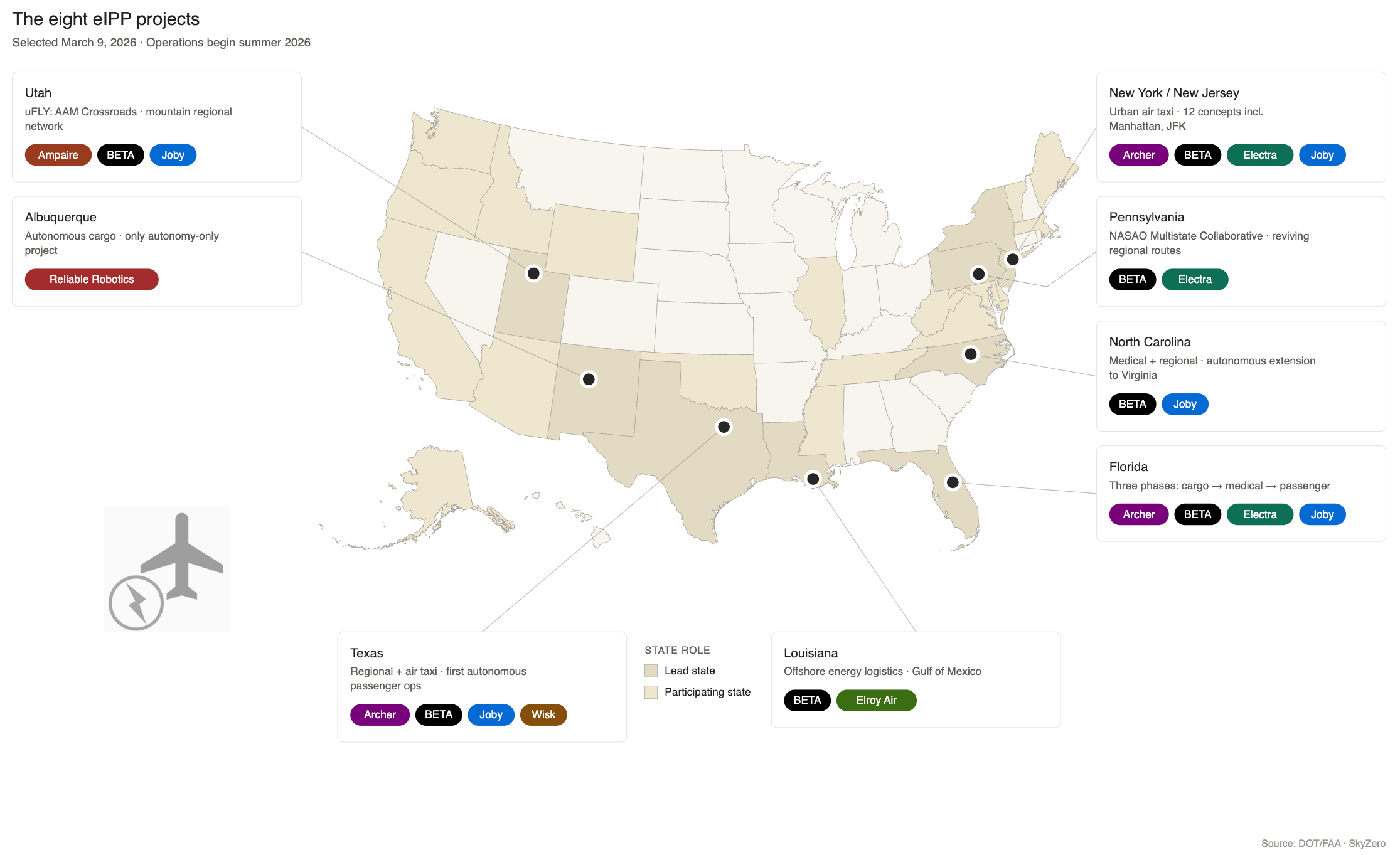
On March 9, 2026, the DOT and FAA announced the eight projects selected from more than thirty proposals. The selections are led by six states (Texas, Florida, North Carolina, Louisiana, Pennsylvania, Utah) plus the Port Authority of New York and New Jersey and the City of Albuquerque with partner state participation covering 26 total states in the USA. The Federal Register notice published in September 2025 had laid out evaluation criteria that emphasized geographic diversity, operational concept diversity, state, local, tribal and territorial government (SLTT) readiness, and aircraft-maturity considerations. The eight selections appear to balance all four.
The diversity of operational concepts isn’t only a function of FAA preferences. It also reflects the application structure: SLTT governments and their industry partners chose what to propose, based on what they thought they could execute and what the local political economy could support. Louisiana proposing offshore-energy-adjacent logistics with BETA makes sense given the Gulf’s existing helicopter infrastructure. North Carolina proposing medical and regional operations with Joby and BETA reflects the state’s existing rural healthcare logistics challenges and its established medical aviation footprint. Florida’s comprehensive medical-and-cargo-plus-air-taxi proposal reflects the state’s existing emergency response infrastructure and tourism-driven appetite for premium transport. New York’s air taxi focus reflects the political will to make Manhattan-area heliport operations work for AAM.
The map of where eIPP operations will happen in 2026 tracks the geography of winning applications, which itself reflects SLTT governments invested in proposal development.
Where the OEMs are in the certification process
Before walking through the eight projects, it’s worth going over where the leading manufacturers sit in the FAA’s certification process. Headline coverage tends to talk about “the eVTOL companies” as a single group, but the certification dynamics are different across the eight aircraft in play. These distinctions determine timeline, scope of FAA review, what evidence the applicant has to generate, and which other regulations come along for the ride. Lumping all eight together as ‘eVTOL companies’ obscures more than it explains.
We’ll group the OEMs together as “eVTOL” projects, which rely on §21.17(b), and others that rely on “Part 23”, an older regulation for small aircraft.
