
Electrification lessons aviation should (and shouldn’t) take from EVs
Lessons from EVs: Battery pack

It’s tempting to look at electric aircraft in a way that’s similar to electric cars. After all, they need many of the same components to electrify the powertrain - batteries, electric motors, even DC fast chargers. Like in automotive, charging speed matters a lot sometimes, and other times it doesn’t. Like in automotive, you have your full EV, plug-in hybrid (PHEV), “mild hybrid” (HEV), and even fuel cell (FCEV).
In this series, we’ll look at how the comparisons do stand up, and how they don’t. First, let’s start with the most critical piece - the battery. Future articles will also look at charging standards, and the role and impact of the hybrid discussion, and more.
Batteries: the critical component
In aviation, getting the battery right is the most important thing for the obvious reason: aircraft require a lot of energy to get the aircraft aloft and keep it there. Jet fuel and AV gas carry more energy per kilogram (mass) and more energy per cubic meter (volume) than the current crop of automotive batteries.
100LL AV gas carries 13,000 watt hours per kilogram (13 kWh/kg), which is way more than current gen lithium ion batteries
Gas burning engines are very inefficient- only 24% of the energy in that 100LL is used for useful work, so you end up getting 3,000 wh/kg. This is still 10X what lithium batteries carry, as current state of the art for automotive batteries is around 250 wh / kg, and that just counts the cells, not the battery pack housing, cooling etc
However, aircraft battery packs are able to outsource things like liquid cooling to ground equipment, can eschew things like AC charging entirely, and will definitely aim for lighter approaches to pack building
Thankfully electric motor efficiency is much higher - 80 - 95%, so the amount you can carry in the battery is pretty close to what you can use
Battery cells are coming on to the market now at the 400 wh / kg and 500 watt hours / kg - this is twice as dense as current state automotive, which should enable short haul flights comfortably even if it's still less than AV gas. This is a big unlock for regional (RAM) and urban (UAM) air mobility.
Folks who know the battery world will tell you that there’s plenty of complexity here - do you want less expensive batteries that can charge forever (LiFePO), or the longest range and power per weight and volume you can get (NMC)? Or maybe the new battery chemistry on the block, LMR, which promises to blend the two? When you’re building a battery pack and choosing a cell chemistry, you’re looking at trade offs:
Is this chemistry more or less expensive?
🚙Automotive cares more - while cost control is crucial in aviation, price tag sensitivity is higher in automotive, opex sensitivity is much higher in aviation
Does it hold more or less energy per weight (kWh/kg)? What about per volume?
✈️Aviation cares more - weight impacts aviation fuel efficiency far more than automotive - weight doesn’t impact EV efficiency enough to show a statistical difference, while aerodynamics and rolling resistance are key. Low volume density can impact aerodynamics and passenger carrying capability, though.
How many discharge cycles do you need before battery capacity starts to sink?
✈️Neutral, favoring aviation - while both will be stuck with the warranty costs, I think aviation might trade this off for other characteristics like safety and weight sooner.
How likely is this chemistry to have thermal runaway events?
✈️ Aviation cares more - safety matters to both, but it matters more to aviation. A car can pull over if a problem begins, but pilots can’t stop thermal runaway by cutting fuel like they do today - aviation needs to outright prevent thermal runaway, not merely manage, reduce and detect it.
How fast or slow is this battery to charge?
✈️Neutral, but favoring aviation - fast turnarounds in aviation are key to productivity, and queuing for a charger in aviation is a non-starter, airside tarmac space is tight.
What if a chemistry doesn’t like being discharged deeply?
🚙Automotive cares more - aviation propulsion systems are sized to include a 20 minute+ reserve, so pilots won’t be pushing the pack below 10% very often. Drivers may prefer to drive until a very low state of charge to maximize charging rate and range, given that they can simply stop for a charge and a washroom break.
How happy is this battery if it doesn’t often get charged to full?
⚖️ Not a simple trade off, requires looking at the missions and use cases
Though it doesn’t like to sit at 100%, LMR and LFP chemistry needs operators to charge to 100% at least once a week, or the battery management system will lose calibration of state of charge. No lithium battery chemistry likes to sit above 80% state of charge. While the industry will likely adopt procedures to discharge batteries to 50% when storing them long term, it won’t be an issue otherwise as charging should be followed by a flight (discharge) within 24 hours (and very often within one hour) in most cases.
What about temperature operating range?
This breaks down into a few buckets of operating modes; charging, taxi, and flight.
✈️ In flight
In flight, aviation will incur much lower temperatures than automotive. Electrified passenger aircraft won’t necessarily fly as high as jet aircraft though; Heart’s ES-30 intends to operate at 20,000 feet, and Vaeridion’s Microliner intends to operate at 8,000 feet, where the air temp will be 0c, much warmer than the -60c jet liners face.
In General Aviation, aircraft like Pipistrel Velis Electro can operate up to 12,000 feet, but don’t often do that. The skyzero.io database shows that the Electro series usually operates between 2,000 and 8,000 feet ASL. We’ve spotted Beta’s Alia a bit higher, up to 14,000 feet, but still usually an average of about 4,000 - 6,000 feet. So temps shouldn’t get below -5c.
⚖️ Taxiing (tied)
Temperature for taxiing GA and jet airliners will be impacted by a number of factors - outside air temps might be 45c (110f), and while sitting on a hot black asphalt runway the 55c max that a lithium battery can handle isn’t that unlikely. However, we aren’t operating a thermal engine to heat things up. So far electric aircraft are less sensitive to hot temperatures. H55 flew quite a bit in Arizona and Las Vegas recently, in temperatures up to 110f that were sidelining plenty of piston aircraft, but the H55 Bristell Energic was not having any issues. They also flew in Denver at altitudes around 9,000 feet with no problem. This is likely very similar to automotive.
⚖️ Charging (tied)
When charging, lithium chemistries want to be above 0c, and the act of charging itself generates heat. In automotive this is solved with a liquid cooling system - we’ve learned a lot about the importance of liquid cooling since the Nissan Leaf.
Cars tend to carry a liquid cooling system onboard, but aircraft OEMs are often outsourcing some or all of the liquid cooling problem to ground equipment to save weight, given that liquid cooling is most important when charging given the extra heat. More on this in the charing article coming soon. So its tied; the liquid cooling systems ought to keep the pack at a reasonable temperature in both cases.
Visualizing the trade offs
You might visualize these trade offs as forces, pushing and pulling aviation and automotive OEMs one direction or another on a grid. To simplify the discussion, I’ll combine energy density and charging rate to just “performance”, and cycle count and operating temperature in to “lifespan”, but in reality this is much more like three dimensional chess with more dimensions of trade offs to look at. This is also what I imagine an OEM ought to ask for; but one imagines there would be many cycles of R+D that would eventually lead to the best recipe.
I’d see auto makers as being fairly balanced but leaning towards cost, while I might see aviation in contrast being more sensitive to safety and performance.
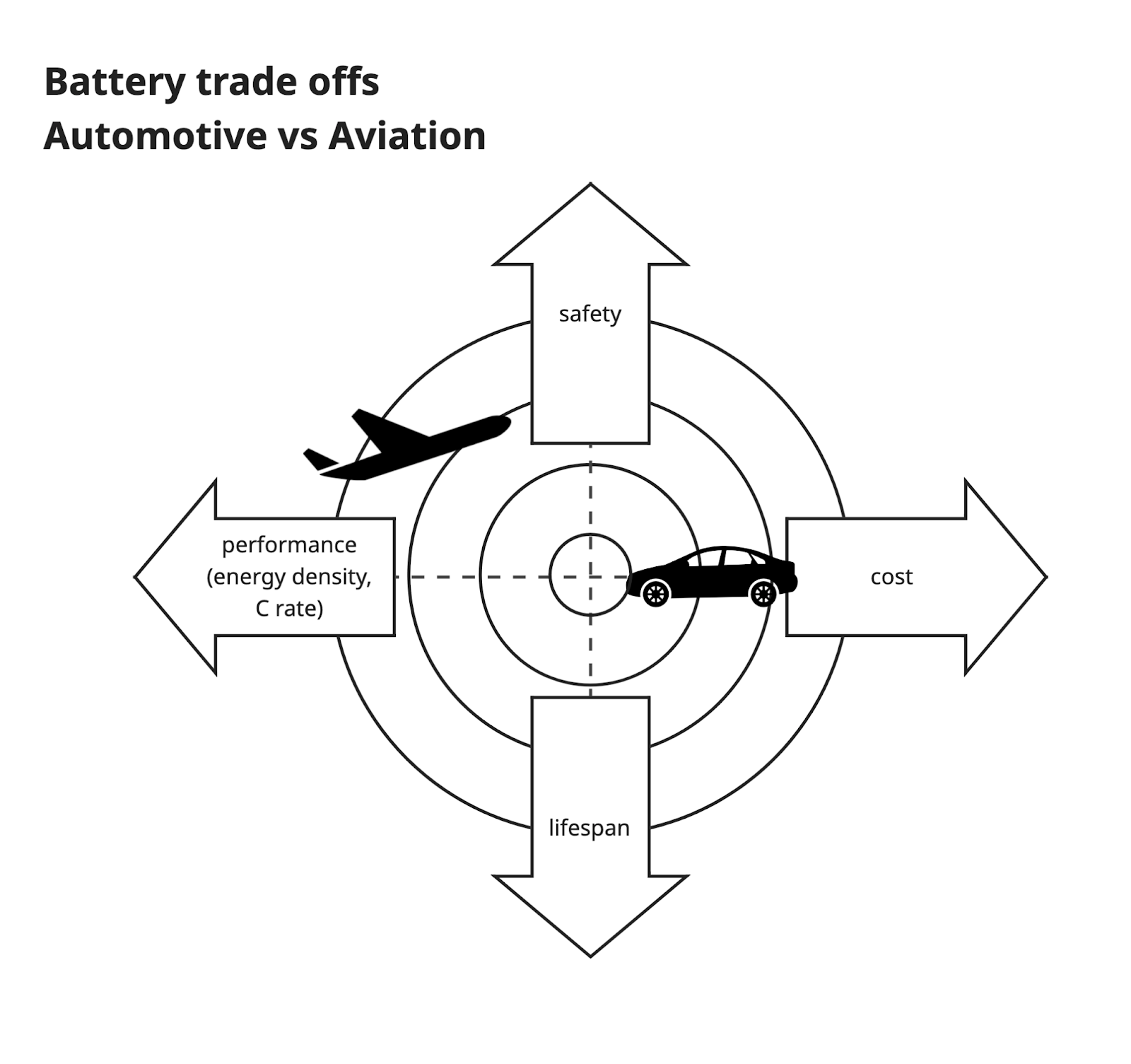
So as you can see, both aviation and automotive care about all of these things, but in a head to head between safety and cost, aviation ought to push harder on safety; same for performance. I also imagine aviation ought to worry less about absolute lifespan and the effects of the operating temperatures by just flying lower - while they need incredibly high reliability, the aviation world is already used to overhauling engines at a certain number of hours and has a rich network of aviation maintenance businesses and fleet management tools to make sure it's happening.
It’s also worth keeping in mind that most battery formulations degrade very gently after the first year - while liquid cooled EV battery packs might lose 4% in the first year, they’ll usually slow down to losing less than 1 or 2% each year after that. Battery OEMs can simply oversize, and the airline will get “extra range” in the first year to handle this gracefully. The point is, it's not like the battery suddenly “seizes up” mid-flight. It just gets a little smaller every year.
Getting the attention of the battery industry
The challenge is that since the needs are so different between automotive and aviation, and the volumes in automotive are so much higher, there’s not a ton of incentive for battery makers to spend the R+D cycles needed to focus on the needs of the aviation market, generally.
The Chinese battery market (which is the largest in the world) is an exception, however, given that the government in China is supporting electric aviation heavily. On balance, while aviation battery tech isn’t yet super saturated, there is progress:
The electric aviation powertrain company MagniX is marketing battery cells that reach 400 kWh/kg, which significantly exceeds the usual range of automotive
The Chinese battery giant CATL announced an aviation battery back in 2023 that aims for 500 kWh/kg, nearly doubling today’s automotive density. Their recent tech day announcements show that it's still making progress; with target dates of 2027-2028.
Hopefully this pattern will continue, enabling electrified aviation to continue to thrive, at least in regions that haven’t complicated things with trade policies. And, with a little luck, Japan and South Korea will begin looking at aviation batteries too.