
The Saab With a Secret Third Engine
GE Aerospace's Farnborough demonstrator is much more than an engine swap

GE Aerospace made a big splash today at Farnborough, flying a Saab 340 that’s been converted to operate as a parallel hybrid.
They also used the hybrid engine all the way from BETA’s Plattsburgh NY facility, to Goose Bay, to Nuuk Greenland, then Keflavik Iceland, and finally to John o’ Groats in Scotland. We have great detail on the flight from Plattsburgh to Goose Bay, and of course the run down from Scotland to Farnborough. During these flights, they maintained cruise altitudes of 21,000 - 24,000 feet and speeds of ~ 240 kts. Three of their flights exceeded 1,400 km.


This isn’t our first hybrid on SkyZero, of course, Ampaire’s Electric EEL, and Aura Aero’s VoltAero Cassio 1 are both independent hybrids. Since they’re based on the SkyMaster, they almost get to cheat; you can just put the gas engine one end and the electric engine on the other1.
Since this is a parallel hybrid, it needs to take on an additional complexity - you’re going to have two engines on the same propeller shaft. Ampaire’s Eco Caravan does this, too. In the Eco Caravan’s case it’s necessary, as Caravan’s are a single engine aircraft.
GE, in partnership with Boeing and BETA, has taken on a little bit more complexity with their conversion.
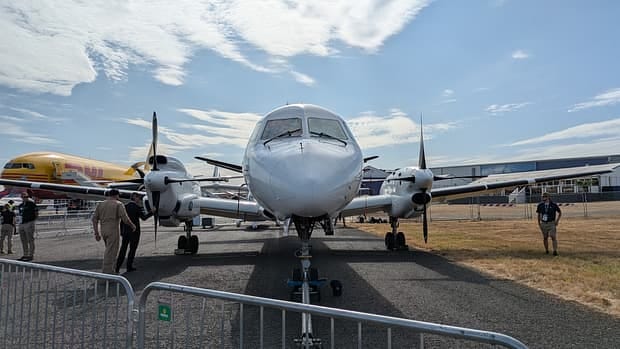
The left engine (pictured above on the right) is the standard GE CT7. The engine on the other side is the hybrid electric engine. The nacelle is “flipped” on the hybrid engine to increase airflow..
So, it's an independent hybrid, right? Like ZeroAvia — hydrogen on one side, turboprop on the other?
Well, yes, but no.
The right engine is itself a parallel hybrid engine.
GE Aerospace developed key components for the hybrid engine, including proprietary motor-generators, controllers, power converters, and inverters. BAE Systems developed the batteries used for the tests, while Boeing subsidiary Aurora Flight Sciences supplied the complete nacelle. GE Aerospace subsidiaries Dowty and Avio Aero provided propellers, as well as gearboxes, and a CT7 engine, respectively.
Chris Young, Interesting Engineering
Avio, the GE subsidiary that made the gearbox has been creating architecture diagrams like this one since 2022:
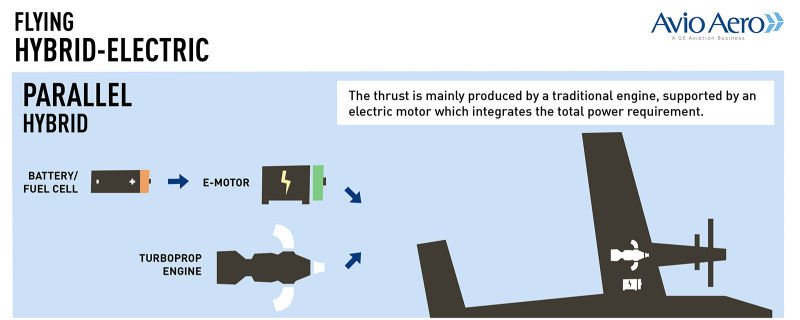
And since GE called it a parallel hybrid, I imagine this is pretty close to what’s happening. They’ve also called it a generator; which makes sense at a minimum to charge the battery driving the electric motor part of the hybrid powertrain.
So I’m imagining the gearbox gets some extra complexity, possibly something like a clutch, that allows either of the pieces of the powerplant to contribute power, and allows the motor to draw power off of the gearbox in order to charge the battery.
They’re describing it as a megawatt class e-motor, and saying that it enables the Saab to act like it has three CT7’s on board, though two of them are located on one wing.
As a reminder, automotive hybrids like the Prius recuperate energy when you slow down - literally, instead of braking in a parallel hybrid you’re generating electricity instead - it’s very handy that an electric motor can be engineered to be a generator and a motor at the same time. This is not at all applicable in airplanes, or at least only a little bit as you go in for a landing - technically you could windmill the prop as you decelerate and generate a little electricity that way, but not enough.
So why build an aviation parallel hybrid? During takeoff, we’re able to draw electricity out of the battery to provide more power for the prop without increasing the size of the engine. that means the aircraft can use a smaller turbine more optimized for cruise, and only use the electric system during take off - so all in all it’s a weight savings, very similar to Ampaire’s Eco Caravan.
And, if you can generate electricity off of the turbojet in flight you could theoretically also drive several distributed propellers with light weight electric motors, like Horizon’s Cavorite or Electra’s EL9 will.
For more on hybrids, here’s our definitive guide:

The GE press release also mentions heat exchangers. Why? Likely the usual reasons that turboprops use them - regenerative heating (increasing the air temperature and fuel temperature coming in to the engine), taking heat out of the gearbox and other engine hotspots. I expect this is made more complicated by the super high temperatures inside a turboprop and the need for a clutch and gearbox capable of combining energy from the electric and combustion engines.
Given all the extra power, GE reports that the Saab was able to cruise at 30,000 feet, not just the 28k it usually stops at. They proved this capability May 20th.

For a moment, I thought about filing this aircraft under “BETA”. This is partially because of the obvious BETA ties - Plattsburgh proving grounds, BETA folks flew the aircraft today during the show. Chris Caputo - BETA’s test pilot and head of flight ops, and Nick Wilson, who served as the chief engineer for the conversion.

I’ve chosen to list it by livery instead - the Saab wears GE Aerospace’s colors - so, you can look for these flights not under “BETA” at SkyZero, but under GE Aerospace.
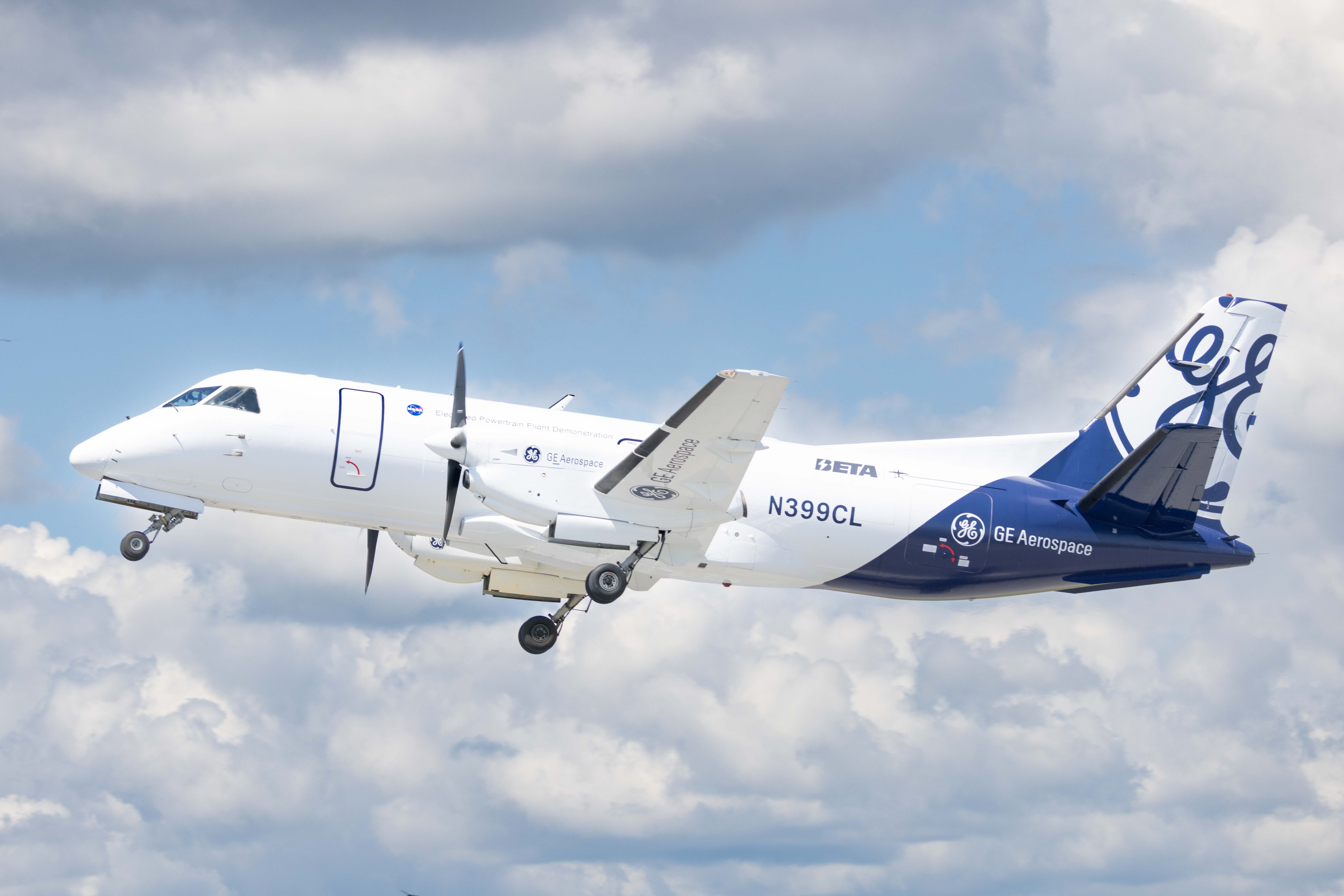
So, should we expect airlines to announce purchase agreements for this Saab conversion?
Not likely in this format. This is a technology demonstrator - much like GE Aerospace’s 747 that wears the same colors.
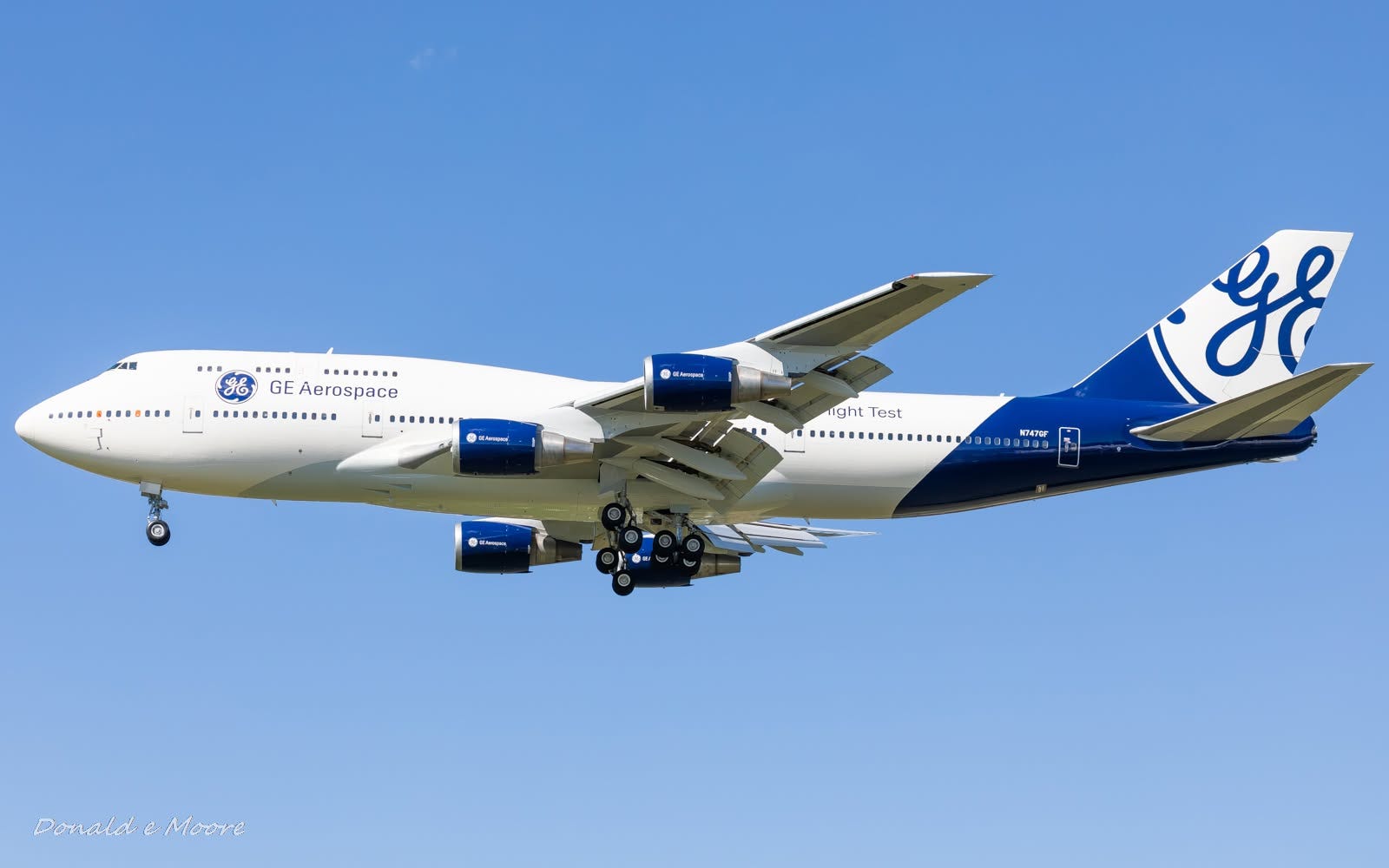
These are both “flying test beds” - aircraft that exist only to have interesting new engines mounted on them. It’s not a design for a new Saab.
Not to say that someone won’t make a small airliner with this modified CT7 - but the aircraft is pretty overpowered in its current “three CT7”s configuration. If Saab 340b’s can fly economically all over the world with two engines, adding a third is going to be a drain on the economics unless it solves some other problem. Maybe they’ll find an aircraft slightly larger, like an ATR-42, and mount two hybridized CT7’s on that2?
In either case, it’s fun to see it in the sky, even if only for a few days over Farnborough.
Let me know, what do you think? Will we see more hybrid jet engines? RTX is working on something similar - so my guess is yes…. mostly a matter of when!
To make things interesting, Ampaire has two skymasters, one with the electric in front gas in back, the other swaps that around, and Voltaero put gas in the back and two electric motors in the front - mounted on the booms, not the nose
Zero engineering work went in to this harebrained idea - it’s just an example, and works on the assumption that “two hybrid CT7s is over powered for the 30 seat Saab, maybe it wouldn’t be for the 42 seat ATR”.