
Electrification lessons aviation should (and shouldn’t) take from EVs: charging
Part two in the series, focused on charging technologies and business models

In the first article in the series, we talked about how aviation and automotive have similar, but different needs of battery systems when electrifying.
What about charging?
Well, the automotive EV world has certainly made many mistakes in the charging arena that aviation can learn from, this is for certain. And aviation charging has some real differences here too. Let’s unpack it! We’ll tackle:
AC charging,
400V vs 800V charging and powertrain architecture,
DC charging port standards,
charging business models,
and analysis;
Then a section on the biggest mistakes that automotive charging has taken:
charger reliability, and
charger finding and payment digital experience.
AC charging
In the automotive world, there are two broad categories of charging; AC and DC. When you hear chargers referred to as “Level One” (L1) or “Level Two” (L2), think AC. So far, aviation doesn’t do AC, so it doesn’t have level one and level two. While this saves weight for aircraft, it limits your landing choices to airfields that have chargers.
What we really mean by “AC Charging” is “don’t worry, there is an AC/DC converter in the vehicle so that you can charge at home or a friend’s house or at work on the regular power grid”. This means that customers can either just use the glorified extension cable that comes with the car (L1) to plug in on a regular power socket, or they can install a slightly more capable glorified extension cable that can run off of a more capable AC power supply (L2).
Since they aren’t expected to perform the roadside miracle of charging a battery pack in 15 minutes, automotive AC chargers can be relatively inexpensive - and without them customers would be stuck, unable to charge at all. Yes, in automotive world extra weight might mean fractions of a second slower 0-60 times, or imperceptibly poorer handling, but for most customers this is far “outweighed” by the simplicity of just plugging your car in anywhere in the world where you can find an AC electrical socket.
Aviation does not do AC charging
So far in aviation world, no one seems to have attempted this trade off, I suspect to save weight. In an aircraft weight is a far bigger problem -
it impacts endurance, design complexity, and operating expense far more than in a car. Pipistrel simply sells customers a DC battery charger with the aircraft that’s designed to stay in the hangar, instead of one that’s built into the aircraft. This makes the aircraft lighter, and makes the charger bigger, heavier and more expensive, since its the thing actually converting the AC power to DC.
As a drawback, it means that an aircraft that lands somewhere where there is no charger is in a bit more of a pickle. I do wonder if we’ll see a line of aviation AC chargers that are light weight and can be stowed away when flying to airports that don’t have charging infrastructure.
400 vs 800 Volt
Charging
In the automotive world, most cars so far have been built with a 400 volt battery pack and charging system, while the fastest charging EVs now use 800V. Examples include Porsche Taycan, Lucid Air, Tesla Cybertruck and Hyundai Ioniq 5/6/9 and Kia EV6/9. Higher voltage means faster charging given the same current, or lighter, less costly systems thanks to lower current, both of which are welcomed.
This is one of those innovations that is a blessing (faster charging) and a curse in terms of some added confusion. Thanks to marketing and Ohm’s law, 800V cars can often draw 180kW on a 150kW charger, and sometimes super fast charging cars like the Porsche Taycan are limited to 50 kW if they’re on a 400V charger and don’t have the right added equipment (and since its a Porsche, this is a paid upgrade).
800V systems often trade off the extra speed for a little extra weight:
For an 800V car, extra charging hardware to deal with 400V chargers without getting really poor charging experiences. Porsche solves this with an extra piece of electronics, while Hyundai found a way to re-use the car’s motor, adding some engineering complexity but saving part count and weight
GMC Hummer EV and Cybertruck took a split pack approach instead, where there are essentially two 400V battery packs, and a switch can charge them either in parallel or in series depending on the charger input
All in all, this is shaping up to be fairly organized for aviation.
Pipistrel is using 400V and the GB/T standard,
While all the CCS aircraft (everyone else?) so far are using or planning 800V.
The confusion and complexity comes in when an 800V vehicle needs to charge on a 400V charger; if all aviation chargers are 800V things should be fine, until we start using 1,600V (1.6KV) chargers at least.
If this does get more complicated, the downside would be that aircraft will either need extra equipment to deal with lower voltage chargers, or they’ll just charge more slowly when connected to one, which will impact turn time. With a little luck we’ll all stick to 800V and save the weight for now.
Architecture
Charging is only one part of the electrical architecture of the vehicle; there’s also motors and inverters. Suffice it to say that higher voltage means lower amperage for the same power; which means that wiring can be lighter. It’s worth considering that the 400V vs 800V conversation is relevant to both, the overall architecture, and the charging as part of that. It’s possible to have an 800V charging system with a 400V architecture like the Hummer EV, you’ll get faster charging, but not the lower weight you could have had with a full 800V architecture.
Charging port standard proliferation
Aviation charging has largely borrowed from automotive fairly successfully- and, there are also moments where aviation has wanted to innovate. Both of these are good; it's nice to stand on the shoulders of giants, it's also nice to innovate and improve things. Unfortunately, an almost inescapable side effect of both is charging standard proliferation. Let’s take a look at the different standards and think through their merits.
CCS
Combined Charging System
Beta has adopted CCS as a standard, both on their aircraft, the Alia, and on their charging network. H55 has adopted CCS for their aircraft, as has Vertical Aerospace and Archer. There is some evidence that Pipistrel intends to use CCS in future, though I can’t find that in any official channels from Textron currently.
Given all the names we mentioned, CCS is the clear leader in aviation for now, at least in the "sub megawatt” space. It’s far too early to call it the long term winner, however - at this stage in the EV electrification race CHAdeMO was still the leader, only to be unseated later by CCS, and then again by NACS in North America.
While CCS is widely adopted, its not a perfect match for aviation.
CCS combines AC charging and DC charging in to one plug. This means that CCS1 uses the North American J1772 for AC, and CCS2 uses the EU Mennekes Type 2 for AC. So, CCS1 cars from North America cannot charge on EU CCS2 chargers without an adapter.
This is a decent decision for cars, which are very unlikely to travel between continents - but I think this will be more problematic for aircraft once they start crossing continents (I own adapters for my EV and forget to bring the sometimes), and complicates design and manufacturing of electric aircraft and charging systems today since the DC standard always includes the AC standard, bringing along extra weight and volume in the form of the inlet that aircraft makers don’t use.
CCS has several benefits:
✅ Widely adopted: CCS is the EV charging standard in Europe, and currently very common in North America. It’s very well understood and widely supported
✅ Open: CCS is supported by other aircraft manufacturers, so its not a proprietary lock in
✅ Dual duty: airports are starting to use EVs airside; F150 Lightnings, Chevy Bolts and so on can charge on the same CCS chargers that aircraft use
✅ Fairly high speed: CCS chargers up to 350 kw are on the market today, and this is likely to improve over time
✅ Global: CCS1 is used in North America, CCS2 in the EU, and both are used in Africa and Asia, which is good. If your CCS2 aircraft ends up at a CCS1 charger, make sure to bring an adapter
Drawbacks:
❌ CCS combines AC and DC charging in one port, but aviation doesn’t use AC yet, so this is extra weight and size without extra value
❌ Missing features that aviation may really want and other standards provide; 28V auxilary power, liquid cooling, better ergonomics, lighter weight and so on
❌ Orientation limitations - Electro Aero, the aviation focused charging company, suggest that CCS shouldn’t be used “vertically” (think: plugging it into the underside of a wing), only horizontally (plugging it into the side of a vehicle) due to the strength of the locking mechanisms, which generally are not designed for a vertical orientation. This can lead to situations where heat builds up, tripping a sensor and interrupting charging. This doesn’t impact H55 or Beta, which both charge “horizontally”. It would be a bigger problem for Joby, which uses a vertical orientation.
This orientation issue may have nudged Joby further down the path they took, building their own standard (GEACS).
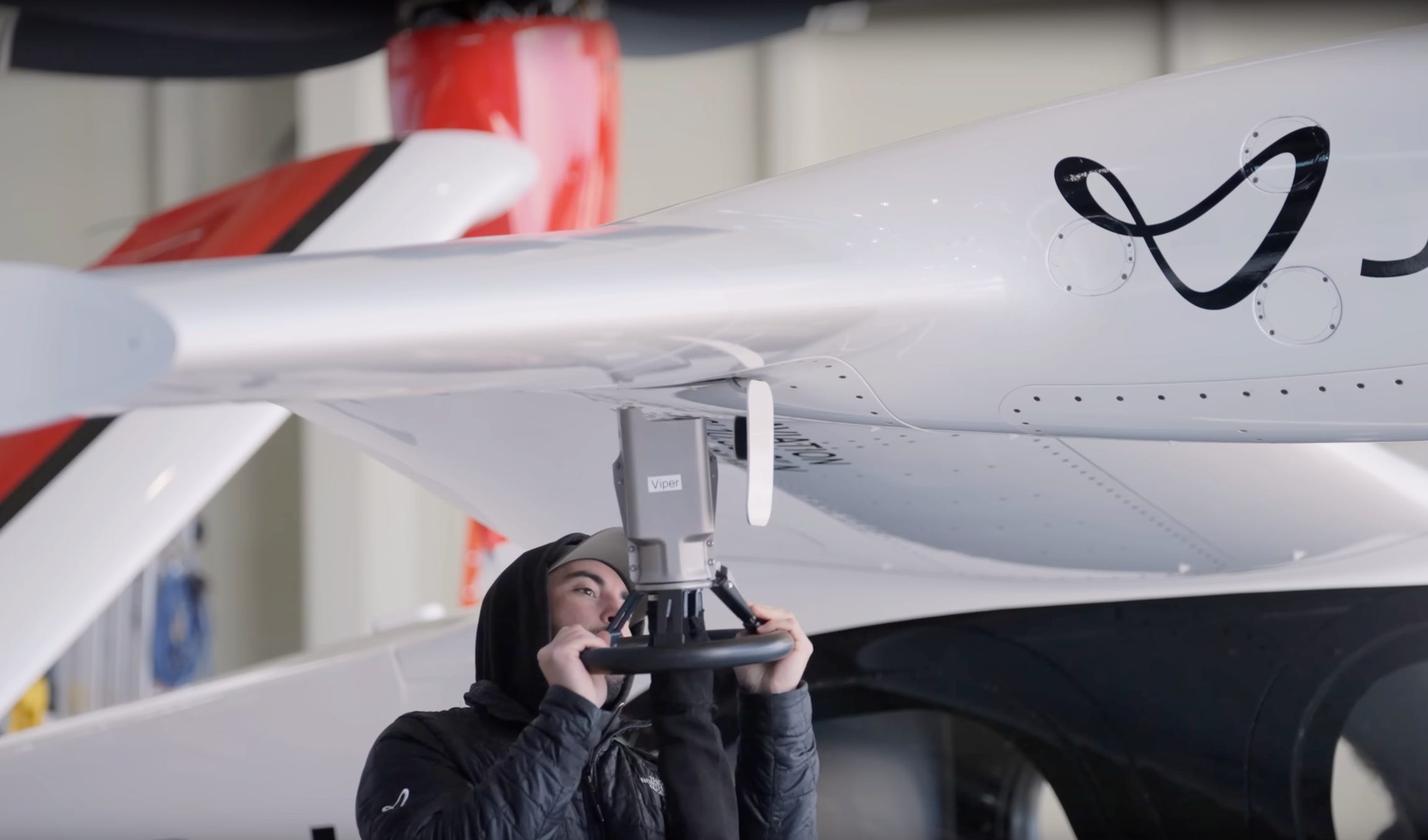
GEACS
Global Electric Aviation Charging System
While Beta may be the undisputed leader in electric aviation charging presence, given their 40+ airport install base, Joby is considered by most to be the player that’s furthest ahead with actual eVTOL flight. They fly their aircraft more than all others combined, and unlike Beta and Archer, who have recently begun to be more active flying in “fixed wing” mode, Joby always flies in eVTOL mode. What Joby does matters, and they’ve chosen to innovate, creating their own standard, GEACS.
There’s an old engineering joke about adding new standards as a solution to having too many standards, and there’s a part of me that wishes everyone would just settle down already and pick one. However, Joby has done some good work here.
Benefits:
✅ Ergonomics - the wheel shaped charging handle with easy to operate locking would make attaching this to the underside of an airplane wing intuitive and easy
✅ Data - includes Ethernet to simplify the transfer of flight telemetry during charging
✅ Cooling - includes a coolant loop saving weight as the aircraft no longer needs to carry around liquid cooling sufficient for high speed charging as the ground equipment provides it
✅ Open standard - Joby has published info about the GEACS specification and intends to make it easy for the industry to follow
✅ High power - while its unclear it’ll go to megawatt levels, it’s already very fast at 320 kW
Drawbacks:
❌ Not in use by anyone other than Joby yet
❌ Brand new standard; while Joby has been using GEACS for a while every time they charge, so the standard has a “lot of miles on it”, but still not as well understood as the others thanks to their automotive history
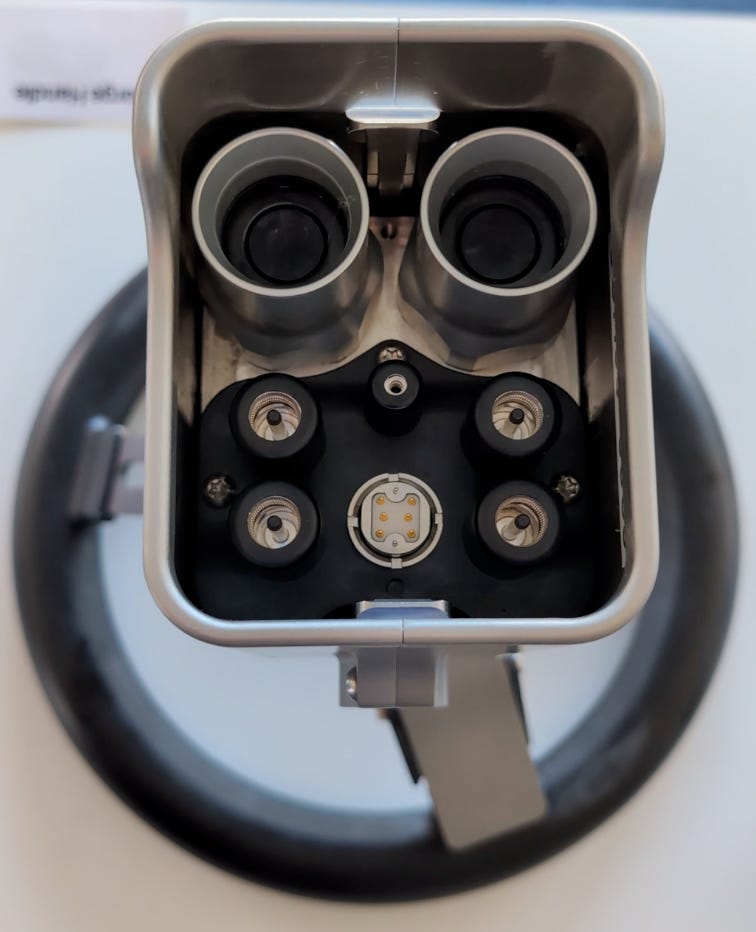
GB/T 20234.3
Recommended National Standard (New energy vehicle DC charging)
GB/T just means “recommended national standard” in China, and there are GB/T standards for paper, book numbering etc among many others - the specific GB/T we are referring to here is 20234.3, which pertains to DC Charging for “new energy vehicles”. We’re just going to call it “GB/T” though for simplification.
The Japanese CHAdeMO standards group has merged with (adopted?) GB/T, and they are working together to come out with a joint standard in future called ChaoJi.
GB/T is also popular in electrified aviation - Pipistrel adopted GB/T for their electro line, which is the most common electric aircraft in the world, flying more miles than any other. They chose it back in 2017, two years after China ratified GB/T for EV charging. It was a simpler time, as you may remember, and this choice of a lightweight, capable, high power, inexpensive broadly supported standard likely looked very compelling. Things are different now, and I'm not aware of any other aviation manufacturer having made this choice since.
So, while it could also be considered the early leader given that its the charging port installed in the most working electric aircraft, its support by the most exciting future players is bleak.
Benefits:
✅ Broadly deployed: since this is the standard in China, and China is the largest market for EVs, that means there is good support for it in market
✅ Solid standard: given its broad use, the bugs have been worked out and equipment is available
✅ Speeds are good, and the standard has a lot of headroom, to 1.2 kw which is 3 times faster than the current CCS theoretical max
✅ Flexible; its an OEM’s choice to deploy the AC variant, DC variant or both, saving some component complexity and weight
🇬🇧 Available today in the UK: very well supported by the AeroVolt charging network in the UK
🇨🇳 Very common in China, and provides dual use for land vehicles and aircraft airside given that its the national standard for DC charging automobiles, and charging adapters might make it work in NA and EU
Drawbacks and limitations:
❌ While GB/T is an open standard, currently no aviation OEMs besides Pipistrel make use of it
❌ Questionable future in aviation (outside of China) - most western aircraft makers entering the electrified market are choosing CCS or building their own standard
What about ground power? (ISO 6858)
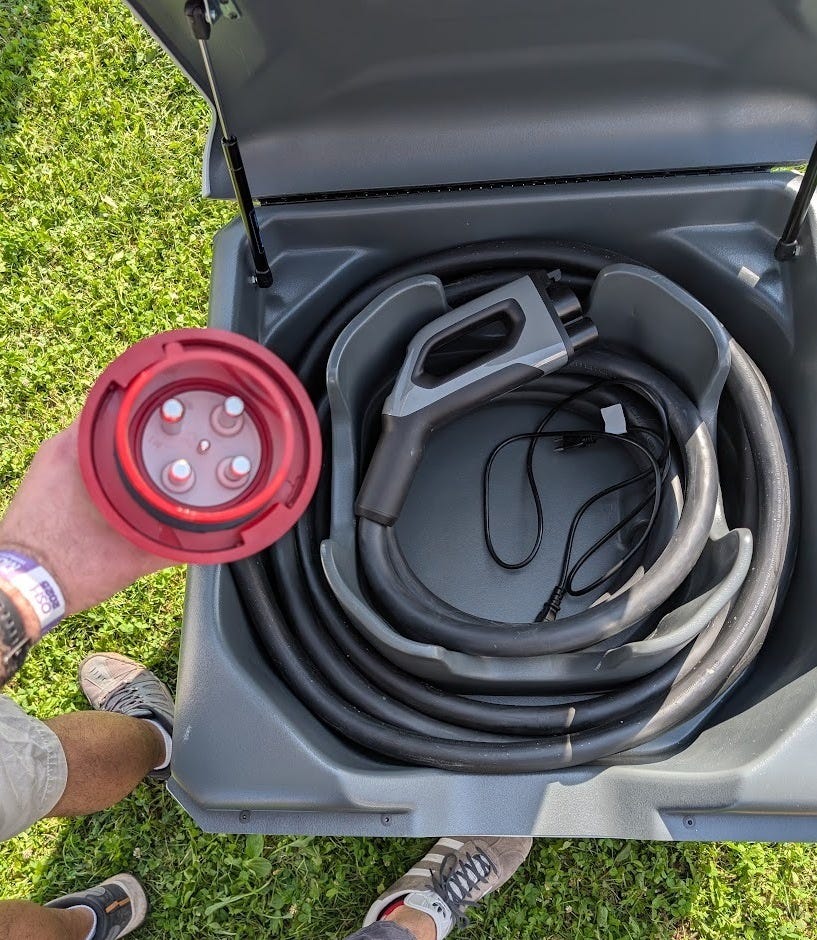
While it isn’t a charging spec, there is already a specification for high voltage power in a hangar or at an airport, referred to as GPU or Ground Power Unit.
It turns out that it's very useful to provide power, either low voltage DC or high voltage AC, to aircraft while repairing them in a hangar, or loading or unloading passengers at the gate.
While no one uses this to directly charge aircraft today, Beta has developed a portable, hangar friendly CCS charger called the mini cube, which can plug into a common 4 pin ISO 6858 GPU connection. This makes installation of the mini cube in a hangar much simpler, just plug it in.
In the works: SAE AS6968
Electro Aero, one of the biggest specialty providers of aviation charging systems, is currently proposing a new standard, SAE AS6968. It’s modelled after GB/T’s DC spec, but has larger charger pins to improve heat characteristics and handle higher amperage. It also includes a feature relying on DC 28V that allows turning on the aircraft without getting in the cockpit, and it also supports high charging speeds up to 400 kW, faster than a Tesla Supercharger (250 kW max) by a considerable margin.
Electro Aero can include the spec in each charger they sell, which provides a nice runway, customers can purchase a CCS or GB/T charger from Electro Aero today and simply add a charging cable with the AS6968 plug down the road if an aircraft OEM does choose to support it.
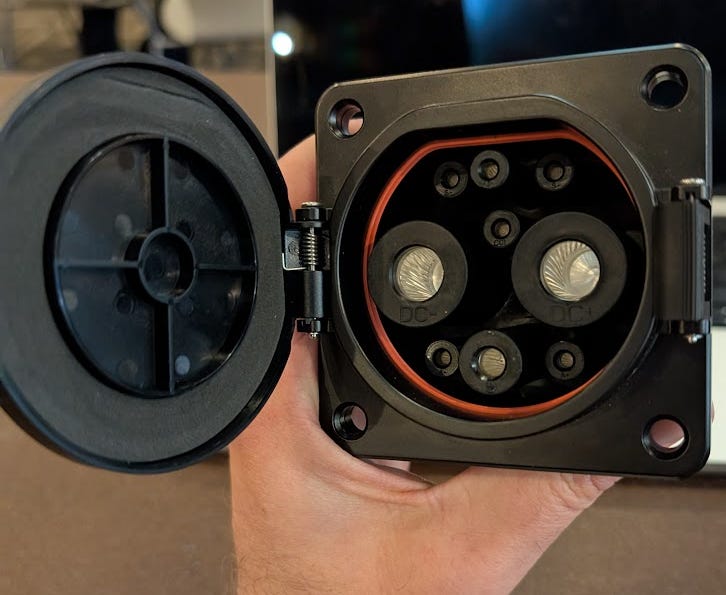
Electro Aero’s SAE AS6968 inlet, which resembles the GB/T DC inlet but provides added functionality
In the works: MCS
Megawatt charging system
Heart Aerospace is perhaps furthest ahead in the regional airliner space, and they talked a fair amount about what they’re doing in their “Hangar Day” this year. One of the things they were bullish on was MCS, or megawatt charging system. MCS is managed by CHARIN, the standards body also in charge of CCS. MCS is usually talked about in terms of electric trucking, as it's designed for ultra high power applications. This could make sense for aviation, and Heart Aerospace joined the board at CHARIN responsible for MCS back in 2022.
MCS isn’t yet in operation and hasn’t finished design, so it's hard to give a proper pros/cons list. If I were designing a regional electric aircraft, I’d be looking at it. Lilium was looking at it before their rapid unplanned disassembly as well. Tesla Semi aims to use it, as will Volvo trucking, Scania and others.
Aviation has not dodged the charging standard proliferation bullet
As you can see, so far aviation has brought in nearly every automotive standard and begun creating their own, so we haven’t yet managed to learn from the EV industry. I’m a little torn - building on existing well tested specs sounds smart - but the innovations that Electro Aero’s AS6968 (28V to turn on the aircraft, charger responsible for locking to save weight) and Joby’s GEACS (provision of charging cooling, ethernet, wheel shape handle for added usability) are hard to ignore.
I will be watching carefully to see how the new “aviation first” standards, GEACS and AS6968 do. They have the benefit of focusing on aviation, and the drawbacks of having to go it on their own. Electro Aero’s website states that they will support both MCS (Heart Aerospace) and GEACS (Joby) when they are finalized in addition to AS6968, CCS and GB/T, which is the right move.
Over the last ten years, EVs have transitioned from CHAdeMo (Nissan Leaf) to CCS, with NACS (Tesla’s standard) taking off now in North America, CCS as the EU standard, and GB/T charging taking off in China and soon Japan as it merges with CHAdeMo.
In automotive, charging speeds started out at 50 kW and held there for a number of years, until 100, 150, then 350 kW chargers started to become normal, though we’ve stalled at 350 kW for a few years now as the top speed.
🔮 Based on this, my forecast for aviation:
🇪🇺🇬🇧🇺🇸🇨🇦🇦🇪Different regional groups of countries will do different things, like in EVs;
each regional group will end up with two buckets of standards that will eventually settle down:
⚡ one for DC fast charging, at speeds between 200 kW and 500 kW;
⚡️⚡and another for “megawatt” class aircraft like regional airliners.
Megawatt class won’t need to make an appearnce until 2027 or 2028 as 500 wh/kg batteries and 30 seaters like Heart Aerospace’s ES30 enter the market, and will likely coalesce around either MCS or some megawatt capable aviation specific standard
Normal DC Fast chargnig (Sub-megawatt) will continue to be sufficient for urban air mobility and even smaller passenger count regional air mobility;
as we move in to the future, the “sub-megawatt” category will reach near megawatt speeds, while Megawatt chargers will become multi-megawatt, 15x megawatt etc through the early 2030’s
AC will continue to be a no-show
Which standard will win in these categories and in each region remains to be seen, and I expect plenty of innovation (and its associated proliferation) to come. If we see a phenomenon like Tesla in the EV world, which maintained massive dominance for a solid few years, this will tip the scales in favor of whatever they’re doing.
Charging business models
The next thing we can look at from the automotive industry is the different business models. The fuelling industry in aviation is complex. Small airports might get by with trucking in fuel, FBOs and fuel providers selling with a small onsite tank farm, while larger airports might have jet fuel pipelines, trucking, above ground and underground tanks, several major aviation fuel providers, independent providers and FBOs.
The automotive EV charging business looks a little different, both from aviation fuelling and from automotive gasoline refuelling.
Single connection, single provider in regulated electricity markets
Unlike aviation where you might be trucking fuel in from one company or buying from a provider at a tank farm or buying from an FBO or the airport itself, just about all EV charging companies buy electricity from one place: the local electricity grid. They may have onsite solar and batteries to supplement the grid and reduce costs, but there are very few offgrid capable charging sites like the Tesla Oasis charging site making headlines, and even fewer that are actually fully off-grid. Unless you’re looking at Hybrid or Hydrogen, you aren’t infrastructure dependent, just need a grid connection.
Single grid connection, multiple providers in deregulated markets
In deregulated electricity markets like the UK or Texas, there may be lots of choice between different retailers or distributors. In Texas, for instance, it would be common for each separate FBO and any other customers to have a different “Retail Energey Provider” or REP. The UK is similar here.
Most other jurisdictions will have less choice than this, and many have no choice at all in who they can buy from. Most players in the aviation space likely already have a billing relationship with an electrical utility, distributor or retailer. If you’re in a deregulated market, and expect to start paying the charging bill for an electric aircraft, looking at your rate structure may make sense to see if there is a better deal available.
Public chargers
While the above apply for installing a charger on your premesis, if you end up using a public fast charger the rates will be set by the owner of the charger. For instance, AeroVolt and Beta both list pricing per kWh on their apps and websites respectively. AeroVolt charges £1 per kWh. If your Velis Electro is down to a 10% state of charge, you’ll pay £22 roughly to charge it back up.
If you could have charged it on your own charger, and we use Henstridge UK airport and Octopus energy, you might have paid at most 30p / kWh, so more like £6.50. If you’re visiting Henstridge occasionally, this is more than worth it - if you’re doing it multiple times every day it might start to look like a reasonable decision to install your own charger.
To complete the thought, a C172 running on 100LL that used an hour (8 gallons) of fuel and pay, call it £2.50 - £3.00 per gallon, which is fairly close to the £22 AeroVolt charge. So definitely reasonable for the cross country requirements given that you can charge at your home base prior to take off and for all the circuits.
Automotive charging moving from subsidy driven to economically driven
EV Charging is now a big business, and locations and capabilities are chosen by solid economics; though, in the past they were often shaped mostly by subsidies - this led to some oddly chosen locations and poorly maintained stations. Tesla famously was able to dodge this bullet through a sheer force of will and planning:
Find customers who don’t mind charging at home to buy your cars (think Pipistrel based flight schools with a charger in the hangar)
Build telemetry into the vehicle that helps you understand where the cars are being driven so that you can plan your charging network based on real world use (which is what we’re trying to do at SkyZero.io)
Build fast chargers that will get used on day one since you know where your customers are, where they can already charge (at home), and what attractions and locations they might drive to if only they had a fast charger.
Electrify America (EA) and the other non-Tesla charging networks couldn’t do it this way, of course. While it was funded by Volkswagen, VW didn’t yet have many electric cars on the road, and they had a mandate to build a nationwide network. This all happened before they even launched the ID4, so while they could do their homework, they didn’t have the facts in the same way Tesla did. And while there is good evidence that Electrify America did nonetheless choose some very good locations right off the bat, there are plenty of examples of lesser known charging networks that just seemed to follow the subsidies and plant chargers in less fertile ground; and if they didn’t make money, and were owner operated or poorly managed, they often fell to disrepair.
Things are different now, there are data providers and consultancies like stable.auto that provide great intelligence on where to install an automotive charger for best economic benefit, and the EV charging industry has made a strong turn towards profitability based on customer economics rather than subsidies.
Partnership based
The majority of successful EV charging stations have a location partner and a charge point operator (CPO) partner. Electrify America (a CPO) for instance often partners with major retailers, installing high power charging stations in Walmart or Target parking lots. More recently EA and others have begun partnering with C Store and gas stations, too.
Charge point operators (CPOs) bring a lot to the table:
✅A built in customer base: a good CPO will have lots of customers with their app installed already and are used to using it to find and pay for their charging session
✅Planning: as CPOs have lots of chargers that they are managing already, they have good info on what works; how to price, where to place, what power contracts ought to look like in a region
✅Maintenance: while EV chargers are relatively simple and don’t have that many moving parts, they can take a beating as they interact with the public and are exposed to weather
✅Upgrades: as charging standards and electrical feed requirements change, a CPO is an ongoing partner to keep a charging station up to spec and competitive
What we’re seeing in the aviation side so far
Pipistrel
Hardware
Currently the 800 pound gorilla in the electric aviation world, Pipistrel sells operators a charger they can use in their hangar along with the aircraft, and they use that to charge their aircraft between flights or overnight. While they chose a known, open standard in GB/T 20234.3, Pipistrel states in their manual that only Pipistrel provided or authorized chargers can be used for the warranty to be honored. Globally, this includes Pipistrel’s own SkyCharge line, either manufactured by Pipistrel themselves or their partner Eaton. In Australia, they have also arranged a partnership with Electro Aero that allows their chargers to be used with Pipistrel Electro aircraft.
Pipistrel does not appear to have a charging network, payment capabilities or an app.
AeroVolt
Founded in the UK by Phillip Kingsley Dobson, and now joined by brother Alan Kingsley Dobson, this upstart aviation charging network is quite possibly the first aviation charging network not owned by a major OEM.
Hardware
AeroVolt have begun installing rebadged Eaton Green Motion chargers at aerodromes in the UK to facilitate GB/T charging for Pipistrel Electros. This was featured in a YouTube video with Richard Hammond and James May, where they raced an electric Porsche Taycan against a Pipistrel Velis Electro piloted by the founder of AeroVolt. James even stopped to charge at an AeroVolt charger and had a nice spot of tea at Thruxton (EGHO).
Network
While our UK may not be perfect, its unclear how often AeroVolt chargers get used. Airports with fixed chargers don’t seem to see many more take offs or landings from electric aircraft, and the busiest airports for electric aviation are not AeroVolt charger locations, though they are in range of one of the busiest airports, Fairoaks (EGTF).
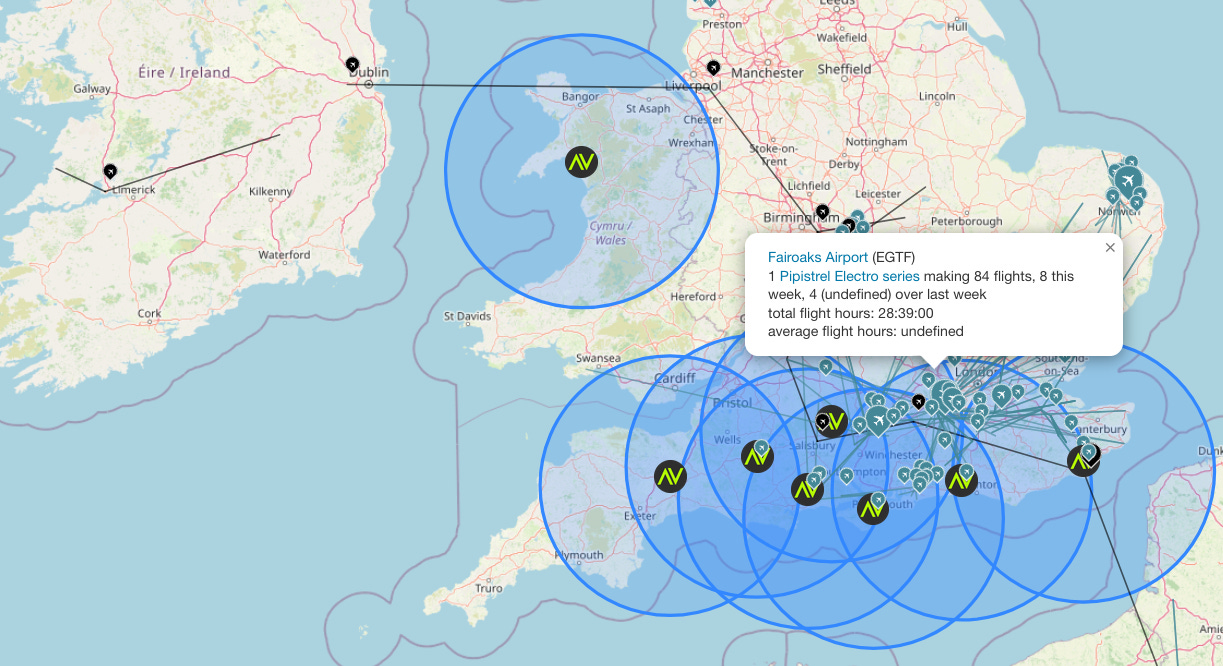
AeroVolt’s network does seem capable of allowing Pipistrel Electro pilots to fly around the southern UK, easily from Lydd (EGMD) near Canteruby all the way to Exeter via the chargers at Dunkeswell (EGTU), with a stop in at the Isle of Wight’s Sandown (EGHN) even.
AeroVolt seems to be expanding into CCS and geographically into the USA, as AeroVolt have announced a partnership with H55 and mentioned possible partnerships with Beta. So, we’re definitely interested to see what’s next.
Software and payments
AeroVolt does have an app, called Squadron. It appears to focus on allowing operators to manage bookings and invoices, but not focused on the charging network itself from what we can see.
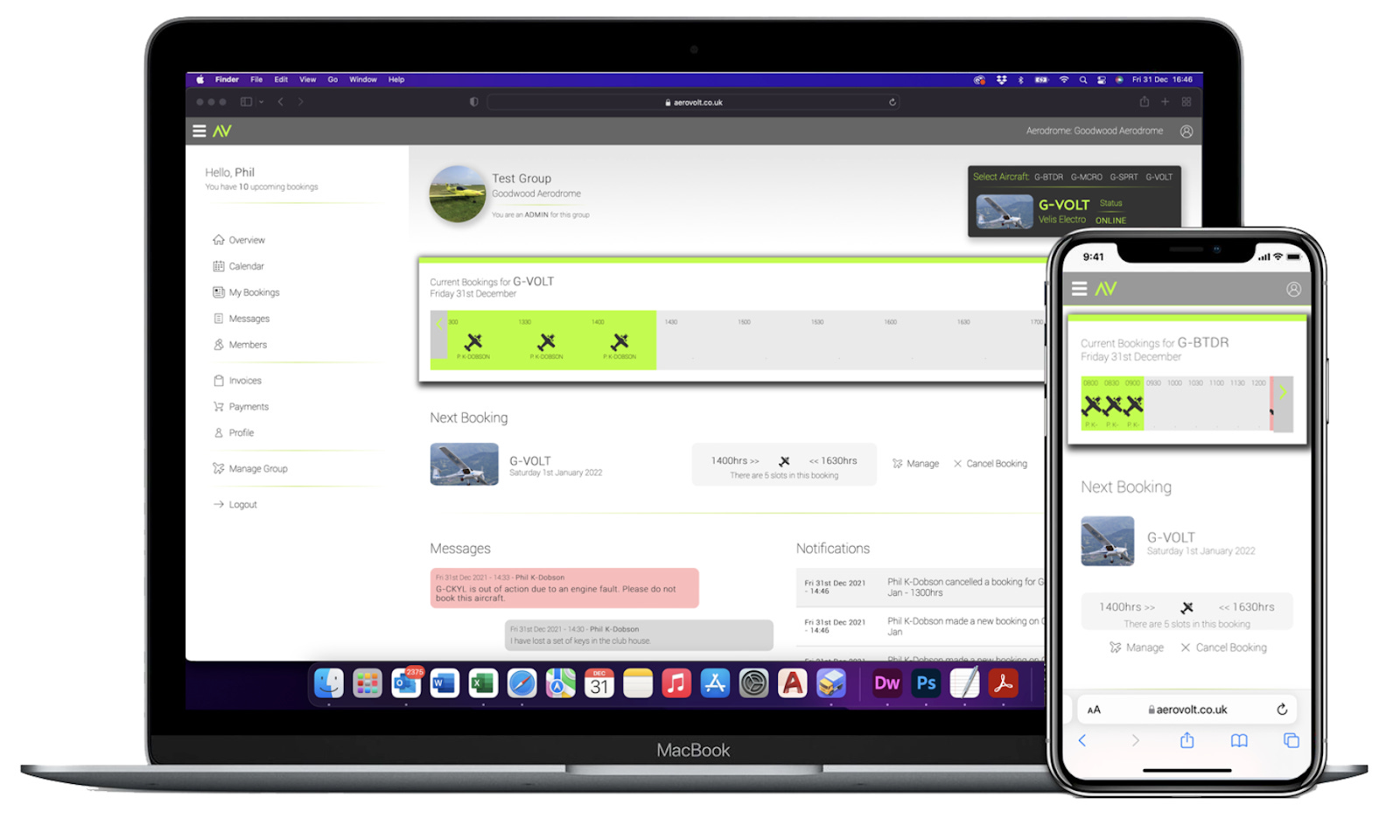
They have made some cool partnerships in payment, too. AeroVolt allows RFID payment with Octopus, which can even bill the electricity to your electric bill. Very fancy! It’s unclear how you would pay if you are not an Octopus customer, though I’m sure more is on the way here.
Electro Aero
Electro Aero is a bit different than the other players here. They’ve focused on the charging hardware itself; perhaps a closer analogy for them to the automotive world would be ChargePoint, who make their own hardware and act as a CPO, though Electro Aero does not appear to be a CPO, they’re instead selling their charging hardware, including a recent announcement to sell their chargers to Bye Aerospace.
Charging standard
Electro Aero is behind the SAE AS6968 standard we described above. This standard builds on GB/T, adding in 28V auxiliary power for aircraft and some other enhancements that improve the original automotive standard for aviation.
Hardware
Electro Aero has, as a charging electronics company, developed a wide range of charging hardware, including fixed chargers, rolling chargers, charging controllers, and even some very cool cable management products designed to make sure that the expensive, temperature sensitive, liquid cooled, heavy black charging cables don’t have to sit directly on hot tarmac.

Beta Technologies
While Pipistrel is the 800 pound gorilla in terms of having aircraft racking up miles, and Joby is biggest in terms of eVTOL hours flown, Beta is hands down the biggest player in terms of having a large, up and running, publicly available charging network.
Network
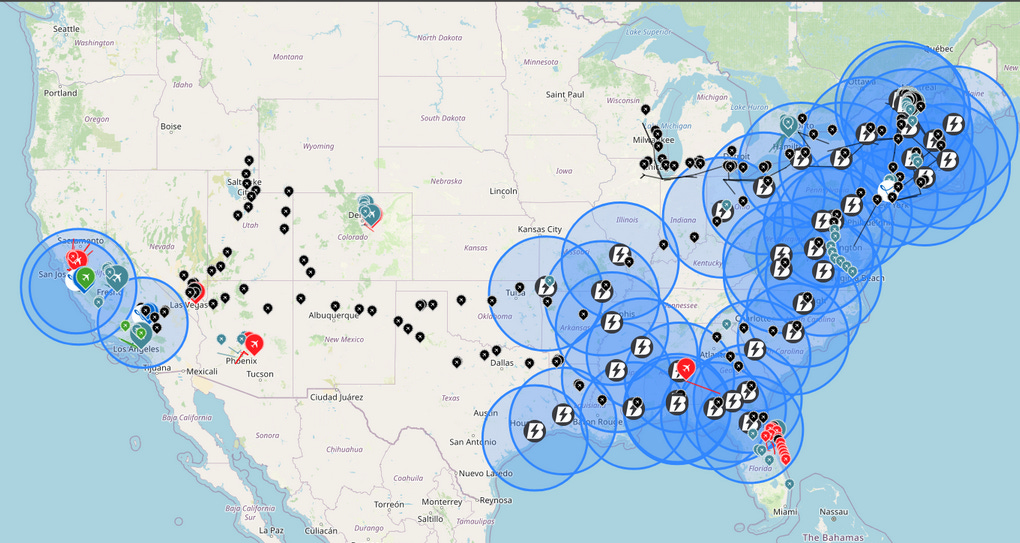
Beta’s network of 40+ stations covers much of the eastern seaboard of the USA. One could easily imagine flying from Beta’s headquarters in Burlington Vermont to Gainesville Florida using Beta’s charging network alone, and then head west to KGLS Galveston, near Houston or even to Walmart’s home base in Bentonville Arkansas. Each station shown below has at least one CCS charger, often at 200kW or even 320 kW. Some even have CHADeMo, which I can only imagine means there is a Nissan Leaf airside at the airport that’s benefiting from the charger too.
Hardware
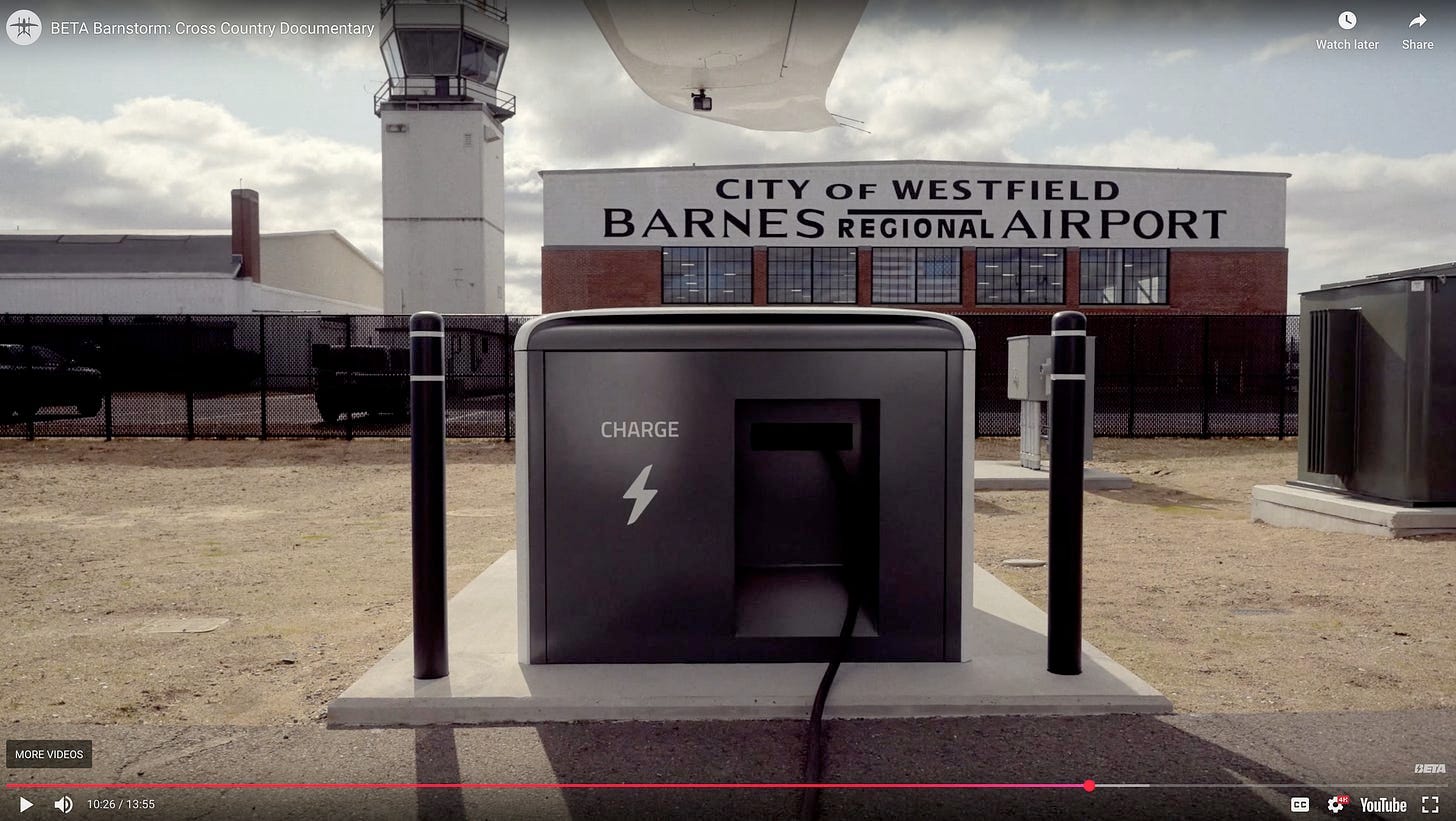
Beta is also providing the industry its aircraft chargers. While the original part of its network is based on “off the shelf” automotive DC Fast Chargers, they’ve developed and have begun deploying a new line of aviation focused hardware. This includes the mini-cube we discussed above, which is perfect for rolling around in a hangar and being put to use; it also includes the fixed infrastructure Charge Cube.
The Charge Cube has been installed at a number of airports already, including Westfield Barnes (KBAF) which is associated with Beta’s FBO partner Atlantic Aviation. Both Charge Cube and Mini Cube are lower to the ground, and have easy to retract longer cables suitable for the task.
Software
Beta has a mobile app to help pilots and operators find chargers. The app is really great, showing both airside and landside chargers, allowing customers to pay, view current status of chargers - it's everything you’d want in a charging app, and it supports both iPhone and Android perfectly. Very well done.
Partnerships
Archer announced that Beta will be the charging partner for Archer’s Midnight eVTOL in late 2023, which explains the Beta charger at Salinas airport, where Archer does its testing.
Joby
As we mentioned before, Joby is the biggest player in eVTOL flight hours. Joby has flown their aircraft from their Marina operating base close to 900 times since September of 2024. While Beta’s achievements in flight are also substantial, they are often performed more in a fixed wing mode, where Joby does not have that luxury, as it has no pusher propeller.
Charging standard
Like we discussed, Joby is designing its own charging standard, the GEACS system. Known for its ergonomic design, aviation focused capabilities (ethernet to download flight logs, liquid cooling system to cool the aircraft while charging), GEACS has apparently been opened up to the public, though we have not seen any evidence that anyone, besides Joby, is actually using the standard today.

Electro Aero has talked about supporting GEACS once more is available, and its our understanding that they’d aim to support it both with and without liquid cooling if possible.
Booking and payment
Joby through its history with Uber Elevate has agreements with Uber in addition to the agreements they’ve signed with Delta and Virgin Atlantic to book passengers.
Charging network
A few announcements have happened about Joby chargers being installed. SkyZero.io lists these at Marina, where they operate, Edwards Airforce Base, and HHI Kearney in New Jersey, though there are also reportedly chargers being installed at John Wayne airport (KSNA) in Orange County.

We cannot find photographic evidence of any of these Joby chargers; they either have not been installed yet or are under very tight wraps. We have found (thanks to the Reddit JobyAvation community) footage of GEACS being used in South Korea, though this was likely a mobile charger used for an event.
Software
Given that Joby is partnering with Uber, it's likely that the first mobile app will be, well, Uber, or some version of it. This will come with a massive built in customer base and a world class booking experience. Though they intend to open their charging standard, It’s unclear if Joby’s charging stations will be made available to others, so they may not ever have a “charge finder” app like Beta’s.
Analysis
If we were to look at this through the framing of automotive charging, it might go like this.
Beta Technologies is taking notes from Tesla and Electrify America’s playbooks
Similarities:
✅ Building the charging network and the car aircraft at the same time; (Tesla)
✅ Becoming a charging partner for competitors like Archer, a move similar to Tesla’s move to open its network to Ford and then pretty much everyone else; (Tesla)
✅ Customized proprietary charging hardware, but drawing the line at proprietary charging standards (EA)
✅ Similar obsession with ergonomics given the lower to the ground charging hardware and retractable cables (Tesla)
✅ Very pilot friendly culture and brand (Tesla)
✅ Instead of waiting until the aircraft were out and operating (❌Tesla), built a network ahead of time making use of subsidies (EA)
✅A range of products (Beta: charging, motors, aircraft, defense), not just an epxerience (Tesla: cars, trucks, Powerwall, Megapack, solar)
Electro Aero is focused on aviation charging hardware
Electro Aero’s sister company, Fly on E, seems to be focused on creating an aviation booking business and even an airline. Electro Aero seems more focused on the charging hardware itself. It’s an interesting separation into two businesses, a stark contrast with Joby’s “all in one” approach. It more closely aligns with the playbooks of charging hardware companies, like ABB or even Green Motion that make Pipistrel’s chargers, with the exception that they’re pushing innovation much further.
Joby’s playbook borrows from Uber, Tesla and Apple
✅ Build demand through the Uber app and high end airline partnerships (Uber)
✅ Innovative, proprietary-ish charging standards (Apple)
✅ Focus on the vehicles and market first, let the charging fast follow (Tesla)
✅ Own the customer experience top to bottom (Uber, Apple), with the notable exception of military contracts
✅ Brand is more experience and customer oriented with a touch of the exclusive (Apple)
AeroVolt is focused on building a charging network and tools for pilots
AeroVolt, while a smaller player focused only on charging, appears to have similarities to both Electrify America and Uber’s strategy
Similarities:
✅ Choosing existing standards (EA)
✅ Doing good research on where customers might be (EA)
✅ Re-branding hardware to build brand awareness of the network (EA)
✅ Integrated payments (EA)
✅ Focused early on the operators experience, AeroVolt allows potential paying public to purchase training hours or experience flights directly on their website, though it appears to mostly be a lead gen form at the moment (Uber)
Biggest lessons to learn from EVs
Reliability challenges
While aviation has already started to repeat the charging standard proliferation issue (this may be unavoidable), we can still dodge the biggest mistake in EV charging: reliability.

The picture above says it all - a CCS charger handle, smashed up, possibly driven over - missing its lock connector, and duct taped back together. This is from my personal photos collection, dear reader, so I can tell you that despite the best intentions of duct tape wielding good Samaritans, this charging session did not work out.
Tesla’s charging network is famously reliable even in the beginning, in stark contrast to the other early charging networks and CPOs. In the bad old days, EV drivers would frequently arrive at chargers only to find all sorts of horror stories:
❌ Decommissioned chargers
❌ Broken chargers
❌ Improperly maintained chargers
❌ Charging handles smashed
❌ Chargers that require apps for payment, but there’s no cell service or wifi in the underground garage making the app install nearly impossible
❌ Chargers that require credit card payments but the card reader is down
❌ De-rated chargers (not able to operate at their max speed to avoid demand charges)
Things are much better now, large players like Electrify America and EV Go have cleaned things up significantly, and the majority of charge sessions at major networks now work just fine. Many non-Tesla EV drivers still swear by rules like “never choose a charging station with only one unit, what if it's down?” or “only go to x, y or z network and prefer the ones that have more than 4 chargers”, as there are still low quality chargers out there.
My theory is that what made things so bad in the “bad old days” is that there were many inexperienced owner operators of chargers, and semi or fully negligent operators (CPOs) - companies that did not invest in maintenance or availability, leading to regular poor experiences.
Many of these closed up shop or were swallowed up by larger CPOs who took better care of their network. Even Electrify America, who leads the way today, had a bad stint between 2022 and 2024. Thankfully, their recent large investments in maintenance have cleaned things up considerably.
You could probably build an argument that poor charging experiences for non-Tesla drivers amplified the super strong demand Tesla enjoyed for so long. Electrify America cleaning up its act has probably been part of the reason that non-Tesla EV sales have improved lately, though, certainly there have been other issues at Tesla lately.
I have no doubt that the same will be true for electrified aviation - aviation businesses that have a solid charging story will thrive, those that make charging the customer’s problem will face issues.
Aviation businesses that have a solid charging story will thrive,
those that make charging the customer’s problem will face issues.
Finding appropriate chargers
One of the things that makes Tesla great that often gets overlooked is the in-dashboard route planning; Tesla’s in dash infotainment system can route you from anywhere to anywhere else, complete with the list of what charging stops you’ll need to make and whether or not there are decent coffee shops nearby in seconds. Non-Tesla drivers either suffer through poor in dash experiences, or more likely just use a 3rd party route planning app.
Pilots and operators will need to be able to find chargers that will work with their aircraft and their mission, and they’ll need the charging sessions to work reliably, including payment. In fuel based aviation this is a solved problem; though it's unlikely that the current solutions for aviation fuel will translate. FBO’s seem to be a good start - and we’re seeing many of the airframers and OEMs partner with FBO’s. Perhaps we’ll see a sort of hybrid FBO / CPO model, where FBO’s will contract out maintenance planning and upgrading to a CPO; or, we might see FBO’s try to take it on themselves. If they do, let’s hope they do it well.
🏆 The only player we see doing charger finding well so far is Beta. Their app is clean, easy to use, easy to find in the app stores, and it works - I’ve personally used it to charge my car at a Beta car charger in Chataqua county airport in New York. Not the airside one, obviously! There was one in the parking lot too.
🥈AeroVolt doesn’t do too bad, they have the map on the website - this plus the Octopus pay is probably a decent start, though folks might want to know if the stations are up or down before flying in, and I’m not sure how folks pay without an Octopus account.
🔮 One assumes that Joby will go from 0 to 60 fairly quickly upon launch, given that Uber is already up and running at scale. It’s hard to compare, of course, given that Joby’s digital experience will likely be rideshare, not charger finding.
They’ll have some bugs to work out, certainly, but it ought to be a darned good experience on day one.
It’s unclear what Archer, Pipistrel, VoltAero, Ampaire, Heart Aerospace, Vaeridion, or Vertical Aerospace will do in digital - watch this space!
Next up
As promised, the next article in the series will focus on different power trains; electric, hybrid, and even a section on hydrogen. Stay tuned!
Why not…
Archer we’ve talked about how they’ll partner with Beta for charging. As for their aircraft, while they flew more in July and June and May combined, we just don’t see them flying as often as Joby Beta and Pipistrel do, so we have less data and we’ve focused on their particular details less. It is rumoured that Archer turns off ADSB when its not required, so they may be flying more than we can see.
Vertical Aerospace is still rather new. Though I’d love to have more data on them, their policy is to fly with ADSB off, and they have permission to do so in their jurisdiction. So, like Archer, not enough data yet.
Ehang? The other Chinese eVTOLs? China’s policy is not to allow ADSB data out of China, and as a result we see very little traffic in China. What we have spotted so far is a single Velis Electro flying near the Himalayas. I do intend to keep digging and find out if there’s a way to represent what’s happening in China somehow.
Lilium? Volocopter? Eviation Alice? We are seeing a little bit of hope around the Voloctiy after their acquisition by Wanfeng / Diamond, hoping there’s more of a story about this soon. Eviation is on a pause, and Lilium is kaput.
NACS charging standard? No one in aviation seems to have been distracted by it, which is likely a good thing for now, given how regional it is it’s unlikely to play a global standard role. It is smaller and more elegant than CCS, though that’s not saying much!
Heart Aerospace, Vaeridion, Ampaire, Horizon, and VoltAero we will get in to in the next article on hybrid powertrains, and none of them have a significant charging story yet to our knowledge.
ZeroAvia we will either talk about soon, either in the next article or in a separate article on hydrogen aviation. There’s a lot to unpack here, and it may well deserve its own article. For a preview, check Reddit for my thoughts on Hydrogen aviation.
Resources
eVTOL.news published a great article titled Competing Standards from Mike Hirschberg about charging standards back in December 2023
If you want to go straight to the source on CCS, CHARIN’s technical specifications for CCS are a good start